Michael Page and Randstad vs Mongooz: Is a Big Agency Still Worth the Fee?
A familiar agency name should earn consideration. The search plan, specialist expertise and delivery should earn the fee.
Quoted 20% for a placement? Mongooz offers a 10% placement fee—half that rate, with AI-native execution and human oversight.
The comparison is against a 20% quote on the same salary basis. Michael Page and Randstad do not have a universal rate established in this article; compare the actual scope and terms of your proposal.
Built for faster execution. Evidence-led shortlists. A 10% placement fee.
A recruiter shouldn't have to rebuild the same search, inspect every profile from scratch, draft every follow-up and chase every interview update to keep a role moving.
Those tasks consume time. They don't all require the judgment you're paying a specialist recruiter to exercise.
If you're considering Michael Page or Randstad for a startup hire, that is the question Mongooz wants you to ask: how much of the execution still depends on a person manually moving the process forward?
At Mongooz, we're building the agency around AI-supported research and automated coordination, with recruiters reviewing the work and owning delivery. Our aim is to let each recruiter spend more time on fit, candidate conversations and closing—and less time repeating administrative steps.
That is the operating model we want founders to compare with an established agency's proposal.
The problem is a process that needs a person to push every step
Consider the work behind one open role:
- Turn an intake conversation into usable search criteria.
- Identify source companies and build a candidate pool.
- Review profiles against the brief.
- Prepare outreach and follow up.
- Coordinate calendars and interview rounds.
- Collect decisions and update the search.
- Track candidate concerns through the offer.
When that work sits in separate tools and depends on repeated manual action, capacity is constrained by the person's available hours. Another role brings another queue of tasks. A delayed update leaves someone waiting. A change to the brief creates another round of rework.
That is the labor-heavy agency model we challenge. The criticism applies wherever the workflow operates that way, regardless of the logo on the proposal.
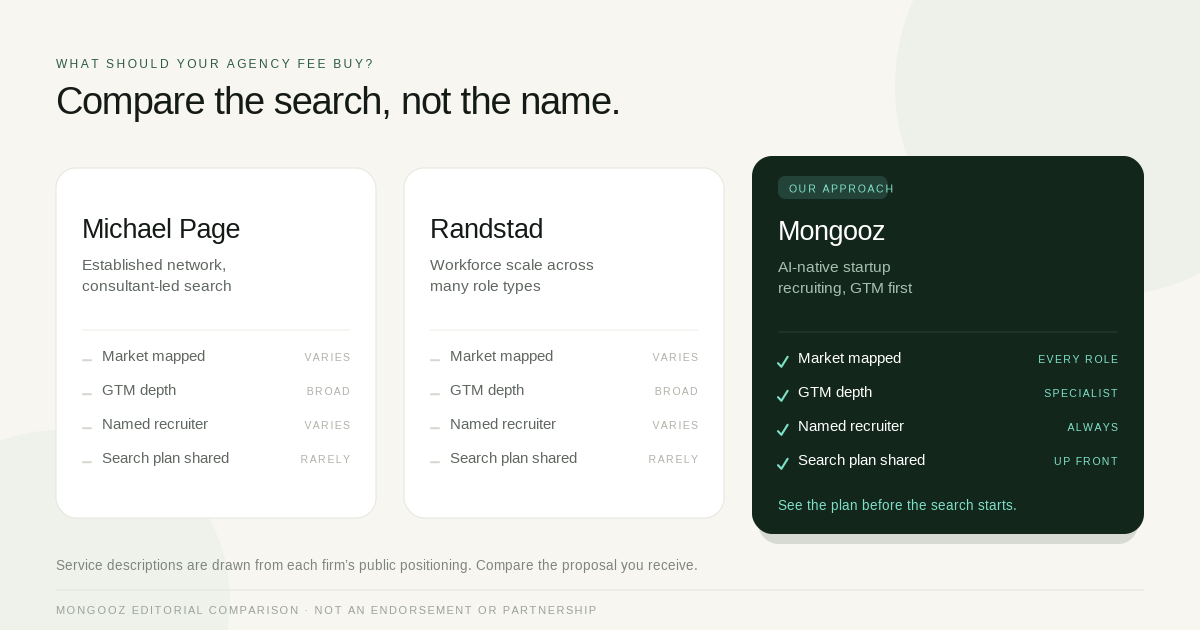
For a buyer evaluating Michael Page, Randstad or Mongooz, ask to see how the work actually moves between stages. A service description doesn't reveal how much manual effort sits behind it.
An AI feature isn't the same as an automated recruiting operation
An AI-written email can save drafting time. A matching tool can help find profiles. Neither, by itself, establishes that the surrounding process has changed.
The more demanding test is whether an agreed brief drives candidate discovery, whether feedback changes subsequent recommendations, and whether coordination proceeds without someone repeatedly transferring information.
Michael Page describes AI-powered sourcing in its India technology practice, while Randstad Enterprise describes its TAP and Lia systems. Those published descriptions don't establish how much manual work remains on your specific engagement.
For the customer, the test is practical: what has been automated, where does a person approve the work, and who handles exceptions?
Ask the team that will run your search. A broad statement about using AI is not enough.
Mongooz: automate execution, keep people accountable
Our recruiting service combines three systems with a recruiter responsible for delivery.
Nia supports market intelligence and brief calibration. The search starts with company context and the pool of people who could fit it.
Shin ranks candidates against agreed requirements. A recruiter reviews the shortlist and the evidence supporting each recommendation.
Zuri supports interview coordination. Scheduling and follow-up sit within the delivery process rather than becoming another task list for the founder.
Our team handles approved outreach, coordination and offer support. The customer assesses candidates and makes the hiring decision.
The human checkpoints have a purpose: challenge the brief, check evidence, handle sensitive conversations and resolve exceptions. They should protect quality without turning every repeatable action back into manual work.
Built for faster execution and better-informed shortlists
Speed should come from removing repeated work. Quality should come from making the requirements and candidate evidence clearer.
Our recruiting approach starts with company stage, team structure, role scope, working environment and expected outcomes. We use that context to guide market research and candidate review across startup functions.
An engineering leader building a team from scratch needs different experience from someone inheriting a mature organization. A designer working with limited research support faces a different environment from one in a large product team. Titles alone don't establish the fit.
A recruiter reviews the recommendations and the evidence behind them. When your feedback changes the criteria, the search should change with it. When candidates reach interviews, coordination belongs to the delivery process.
Less time rebuilding the search. Less calendar chasing. More attention on the people worth meeting.
These are the mechanisms behind our approach to speed and quality. We are not claiming a measured time-to-hire advantage over either competitor.
Recruiter productivity is the real operating question
A recruiter spending less time on repetitive execution has more capacity for work where judgment matters. That is the productivity opportunity behind Mongooz.
More messages sent is a weak definition of efficiency. So is a larger shortlist that creates more work for a hiring manager.
The meaningful measures are:
- Delivery hours per successful hire: the human work required to complete the search.
- Shortlist acceptance: whether the customer wants to interview the people presented.
- Completed hires per recruiter: over a defined period, taking account of role difficulty and support staffing.
- Customer administrative time: work retained outside interviews and hiring decisions.
- Candidate progression: whether relevant, interested people move through the process.
Our design objective is more productive recruiters without lowering the standard of candidate review. We are not claiming a measured productivity multiple over Michael Page or Randstad in this article.
Ask any agency how it evaluates delivery efficiency. A busier recruiter is not necessarily a more effective one.
Automation should change the economics of delivery
In a process dominated by manual work, additional searches create additional demands on recruiter time. Automating repeatable tasks creates an opportunity to serve more searches without adding delivery labor at the same rate.
That is operating leverage. It can create room for more competitive pricing, stronger service, investment in quality or better margins. The outcome depends on the full cost of delivery: people, data, infrastructure, quality review and replacement obligations.
Mongooz's model is designed to pursue that leverage. Higher operating margin is an intended business benefit, not a comparative result established here.
For a customer, our margin isn't the selling point. The useful questions are what the fee buys, how much work we take on and whether the process produces candidates worth interviewing.
For an investor, the corresponding question is whether delivery cost and recruiter capacity improve as volume grows while quality holds. That requires operating data, not an AI label.
Why pay 20% when you can pay 10%?
Mongooz's placement-fee offer is 10%. Against a comparable 20% quote, that is half the placement fee.
For a hire with a $150,000 salary used as the agreed fee basis:
- At 20%: $30,000.
- At Mongooz's 10%: $15,000.
- The difference: $15,000—50% of the placement fee.
This is a worked comparison, not a claim that Michael Page or Randstad always charges 20%. Use the rate, salary definition and included services in the proposal you receive. Compare replacement provisions and payment terms too.
The point is direct: automation should benefit the customer's bill. We use technology to reduce repeatable execution while keeping a recruiter responsible for the search.
The service includes company-context research, recruiter-reviewed candidates, approved outreach, interview coordination and offer support. Your team interviews candidates, provides feedback and makes hiring decisions.
No retainer. A 10% placement fee when your hire signs. The engagement proposal records the salary basis, included scope and applicable terms before work begins.
If you're comparing Michael Page or Randstad with Mongooz, put both proposals on the same basis. Ask what work each team takes on—and whether you need to pay the higher fee for your search.
Why choose Mongooz for your next hire?
Our case is built around the search you need now: company-specific market research, candidate recommendations checked by a recruiter, and execution handled through outreach, interview coordination and offer support.
For a startup, the details matter. A founding engineer, a product leader and a head of operations building a team are different searches. We use the role scope, company context and expected outcomes to calibrate the work before outreach begins.
We want automation to reduce repeated execution while the assigned recruiter remains answerable for delivery. You should understand why a candidate was selected, what still needs checking and who owns the next action.
That is the reason to put Mongooz against Michael Page or Randstad on your shortlist: inspect a recruiting operation designed around your startup's role and the work you want taken off your team's plate.
Questions worth asking before you start
Is Mongooz really half the price?
Our placement-fee offer is 10%. Compared with a 20% quote using the same salary basis, the placement fee is 50% lower. Compare actual proposals for included services and other terms; this is not a blanket claim about every Michael Page or Randstad engagement.
How is Mongooz different from Michael Page and Randstad?
Our proposed distinction is startup-focused delivery: company-context research, recruiter-reviewed candidate evidence and AI-supported execution with human checkpoints. Evaluate those mechanisms on your role rather than assuming every agency delivers them identically.
How can I tell whether an agency really automated the work?
Ask it to walk through one role from intake to offer. Identify what runs automatically, what requires review, how feedback changes the process and what happens when something fails. A feature list won't show the full workflow.
Can automation increase hires per recruiter?
Reducing repetitive work can create capacity. To establish an actual improvement, measure completed hires, delivery hours and candidate quality over comparable periods. Sending more outreach alone doesn't demonstrate it.
Does an automated process remove the human recruiter?
At Mongooz, a recruiter remains responsible for the search. Automation supports research and coordination; people review fit, handle conversations and support the close. The customer makes hiring decisions.
Bring us the role. Ask us to show the process.
If you're considering Michael Page or Randstad for an open role, ask Mongooz for a search plan.
We'll discuss the candidate market, the criteria we'd use, the execution our team would handle and how our 10% placement fee applies to your role.
Why pay 20% when you can pay 10%? Bring us the quote. Compare the work.