Juicebox and Paraform vs Mongooz: Who Runs Your Hiring?
AI can find candidates. The bigger question is who turns that pipeline into a hire—and how much work stays with your team.
You don't need another place to search for candidates. You need the right person hired, with less work falling back on your team.
That's the question behind Juicebox and Paraform vs Mongooz: who takes responsibility for the work between an open role and an accepted offer?
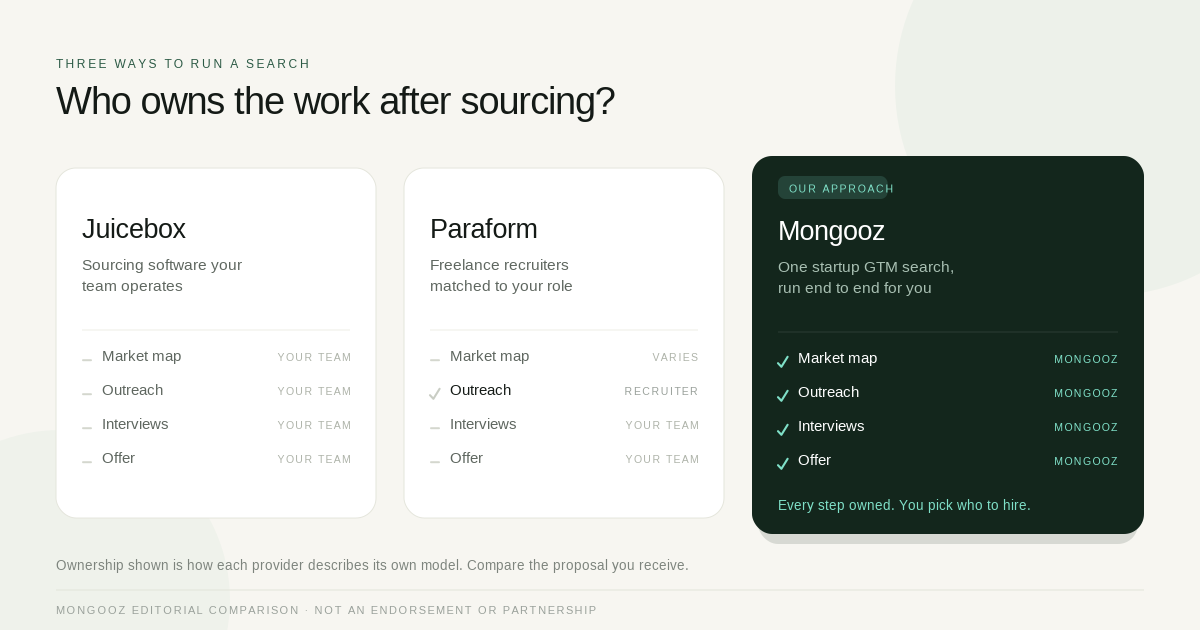
Juicebox sells recruiting software your team operates. Paraform provides recruiter-led delivery through its platform. Mongooz offers AI-native recruiting across startup functions, built around your company's requirements, with a recruiter owning execution and automation supporting the work.
Our argument is simple: the customer shouldn't have to become a better software operator to get recruiting done.
A search prompt isn't a hiring strategy
“Find a senior leader with startup experience” sounds like a brief. It leaves the important decisions unresolved.
Which kind of startup? What stage? What should the person build? How much support will they have? Which past experience is genuinely transferable?
A recruiter operating a search tool must still translate those questions into criteria, evaluate what comes back and decide what to change. That involves judgment as well as prompting. A fluent prompt cannot compensate for misunderstanding the role.
The useful test for a tool such as Juicebox is how much of that responsibility your team retains. Someone still needs to establish whether the recommendations are relevant and how to move the search forward.
At Mongooz, that is work we take on. We calibrate the brief with you, establish the candidate-market logic and review recommendations before asking you to spend interview time.
You bring the business problem. Running the recruiting process is our job.
Finding profiles is one step. Delivery is the purchase.
A candidate appearing in a search result doesn't establish interest, compensation fit or availability. It doesn't book the interview or resolve a change in the brief.
Someone has to connect the steps:
- Understand the role and its expected outcomes.
- Identify and review relevant candidates.
- Run approved outreach and follow up.
- Clarify interest and practical constraints.
- Coordinate interviews and collect feedback.
- Update the search when decisions change.
- Support compensation discussions and the offer.
If your founder or hiring manager is still doing the coordination around those steps, include that time in the purchase decision.
Mongooz combines research, recruiter review, outreach, interview coordination and offer support in the service. Your team interviews candidates, gives feedback and decides who to hire.
That is the distinction we want buyers to evaluate against purchasing sourcing software: how much recruiting execution do you actually take off your own plate?
Against Paraform, the question moves from tools to delivery economics
Paraform is a recruiting service, so the comparison is different. You are choosing between delivery arrangements, not simply choosing software versus a recruiter.
For Mongooz, the argument starts with how the work is organized. Which tasks can run through systems? Where does a recruiter review the evidence? Who takes action when a candidate or hiring manager changes direction?
A process that repeatedly requires a person to rebuild lists, transfer information and chase updates consumes recruiter capacity. Adding an AI tool to one task doesn't automatically remove the handoffs around it.
Our model is designed to reduce that repeated execution while retaining a recruiter accountable for the search. The commercial question is whether the resulting service offers useful scope and value for your role.
Paraform's own May 2026 article quotes an indicative placement-fee range of approximately 20–25% of first-year salary. Current terms require a proposal. On a hypothetical $120,000 salary, those percentages represent $24,000–$30,000.
Why pay Paraform-level fees when AI-native recruiting should cost less to deliver? At Mongooz, we’re building those savings into the service.
At that level of expenditure, ask exactly which work is included and which work stays with you. We want Mongooz's proposal evaluated on that basis: the process, the assigned recruiter, the execution included and the fee.
Why Mongooz starts with your company
A familiar title can hide a completely different job.
For example, an engineering leader who inherited a mature team may have little evidence of building one. A designer used to a large research function may need a different approach in a small startup. A profile can look impressive while leaving the central requirement unanswered.
We start with what the hire needs to accomplish, the environment they will operate in and the evidence that would make someone worth meeting.
Our recruiting approach starts with company stage, team structure, working environment, role scope and expected outcomes. Those details shape the search across functions. We define the work before searching for the title.
That gives the recruiter a basis for reviewing candidates and gives you a basis for accepting or correcting the shortlist.
Automation for the repeatable work. Human review where it matters.
Mongooz uses Nia for market intelligence, Shin for candidate ranking and Zuri for interview coordination, with a recruiter owning delivery.
The purpose is to connect company context, candidate research and execution. The customer shouldn't need to manage each tool or repeatedly explain the brief at every handoff.
Human review has a clear role: challenge assumptions, check candidate evidence, handle conversations and resolve exceptions. Automation supports the research and coordination around those decisions.
When feedback changes the brief, we use it to update the search. When a candidate reaches interviews, coordination becomes part of the same delivery responsibility. Through the offer, the recruiter supports the process while the customer retains the decision.
This is the service we want you to inspect: what runs through systems, what people review and who owns the next action.
A software interface isn't the finished hiring solution
A convincing search screen or an AI-generated message is a visible product feature. Running a search through delays, incomplete information, candidate concerns and changing requirements is a delivery responsibility.
For Mongooz, software is the means of doing the work. The customer buys a recruiting service.
Our aim is to reduce avoidable delivery cost by automating repeatable execution. That can create capacity for each recruiter to manage more work while retaining quality checks. It also creates an opportunity to offer a more efficient service.
The useful measures are accepted shortlists, delivery hours, candidate progression and customer administrative time. A claim about lower cost needs the full delivery bill behind it; a claim about recruiter efficiency needs more than outreach volume.
The standard we are building toward is a complete hiring workflow that requires less repeated work—not another subscription the founder has to operate.
What you are buying from Mongooz
Bring us the role. We work with you on the brief, research the market, review candidates, run approved outreach, coordinate interviews and support the offer process.
You should know:
- Why a candidate was recommended and what still needs checking.
- Which recruiter owns the search.
- What our team handles and what we need from yours.
- How feedback changes subsequent work.
- What the engagement costs and when payment is due.
Our published agency model has no retainer and a placement fee when the hire signs. The proposal specifies the fee and engagement terms.
Against Juicebox, our case is that you can buy delivery instead of taking on software and the recruiting work around it. Against Paraform, our case is the operating approach we propose for your search: company-specific research, human review and connected execution, evaluated alongside the commercial terms.
Frequently asked questions
Do I need to learn prompting to work with Mongooz?
You explain the role, business context and requirements. Our team handles the research and operation of the systems, reviews the recommendations and works with your feedback.
Does Mongooz only provide a candidate list?
No. The service includes research, recruiter-reviewed candidates, approved outreach, interview coordination and offer support. Your team interviews and makes hiring decisions.
Is Mongooz cheaper than Juicebox or Paraform?
Compare the full cost and scope of the engagement. Juicebox charges for software; a managed recruiting service includes delivery work. Mongooz provides a proposal for the role, so you can assess the fee alongside the internal work you retain. This article does not claim a verified universal price advantage.
Bring us one open role
If you're considering Juicebox or Paraform, ask Mongooz to show you the search plan.
We'll discuss where we'd look, the experience we'd investigate, how we'd run delivery and what the engagement would cost.
You shouldn't have to assemble a recruiting operation to make your next hire.